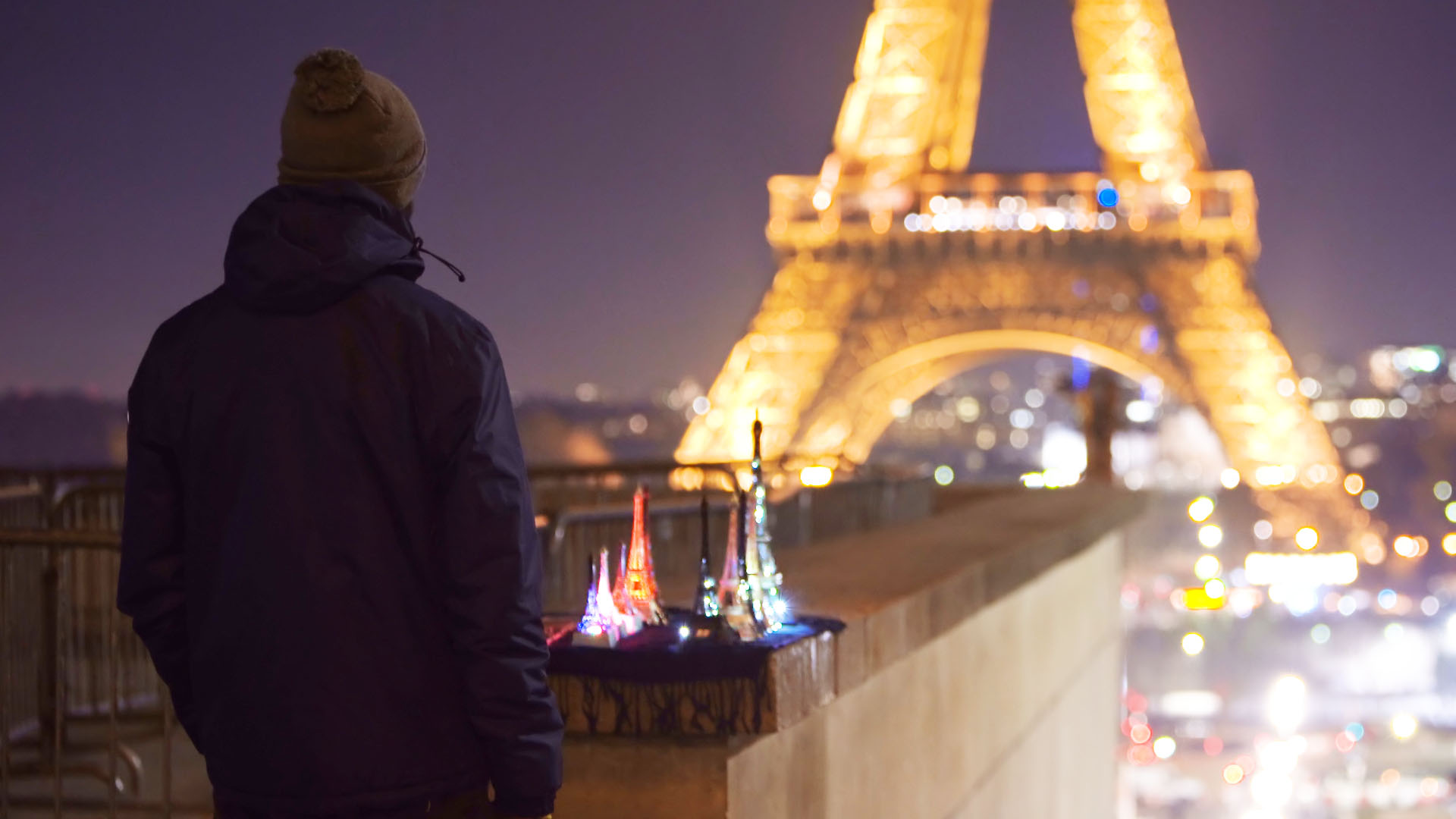
Again a backdrop of beautifully-shot, meditative visuals, we hear the voice-over narrative of Senegalese refugees, now living underground in Paris, barely surviving by peddling souvenirs to tourists at the foot of the Eiffel Tower. From hunger and cramped living conditions to family separation and harsh – often sadistically cruel – treatment at the hands of the police, we come to understand the many ways this life is “Dafa Metti” (“difficult,” in Wolof). It’s a word that settles in through repetition: no need for the pleasant variety of synonyms, this is just difficult, and it wears you down.
Strangely, eerily, we hear the stories, but never see the very real people behind the voices, except at a distance, or through their absence: frame after frame is filled with empty beds, hastily-vacated rooms, hollow spaces. As one of the refugees explains, “if you don’t have papers, you’re nothing – you work, but you don’t exist.” (One suspects this technique also provides a clever resolution to that common documentary challenge of protecting the identities of subjects living outside the law – far more elegant than the jarring use of computer-blurring.)
By erasing the physical beings at the center of the story – while foregrounding their voices – the film also establishes a poignant juxtaposition between the heavy pain and longing we hear and the light, lively, often trivial world we see: tourists on holiday the sparkly “City of Lights.” The camera delights in the magical play of the light on the Seine, which is rendered ominous as we contemplate the desperation of the outcasts who plunged to their deaths under that cold water, fleeing police for fear of capture. Like a form of visual punctuation, the camera often returns to meditate on the absurdly frivolous wares of these street-peddlers: wind-up birds; hundreds of led-illuminated miniature disco monuments; and the aimless wandering of herds of battery-operated barking dogs.
As a result of understandable time constraints, many documentary shorts feel uncomfortably rushed, eager to lay out the evidence, make a closing argument, and get out before the next film in the program. Here Amiran is to be commended, allowing the story to slowly unfold and just sit there, without needing to offer a pat solution. It is a rare feat to create such reflective space in the span of just 15 minutes of film, but Amiran pulls it off masterfully.
In the end – despite the attempts at optimism in the words of one of the refugees, who promises “in the end, we will succeed” – the closing image ominously undermines even this desire for a hopeful ending, as we watch one of those silly dogs, barking, struggling against an obstacle, and eventually give up the ghost.
The film has already been recognized with prizes for Best Documentary Short at a number of festivals, including Nottingham, Woodstock, and Saint Albans. If you see it come near you, be sure to catch it — and keep an eye out for Amiran’s further work.